
I Stopped Calling It the Good Life and Asked Who I Was Living It For

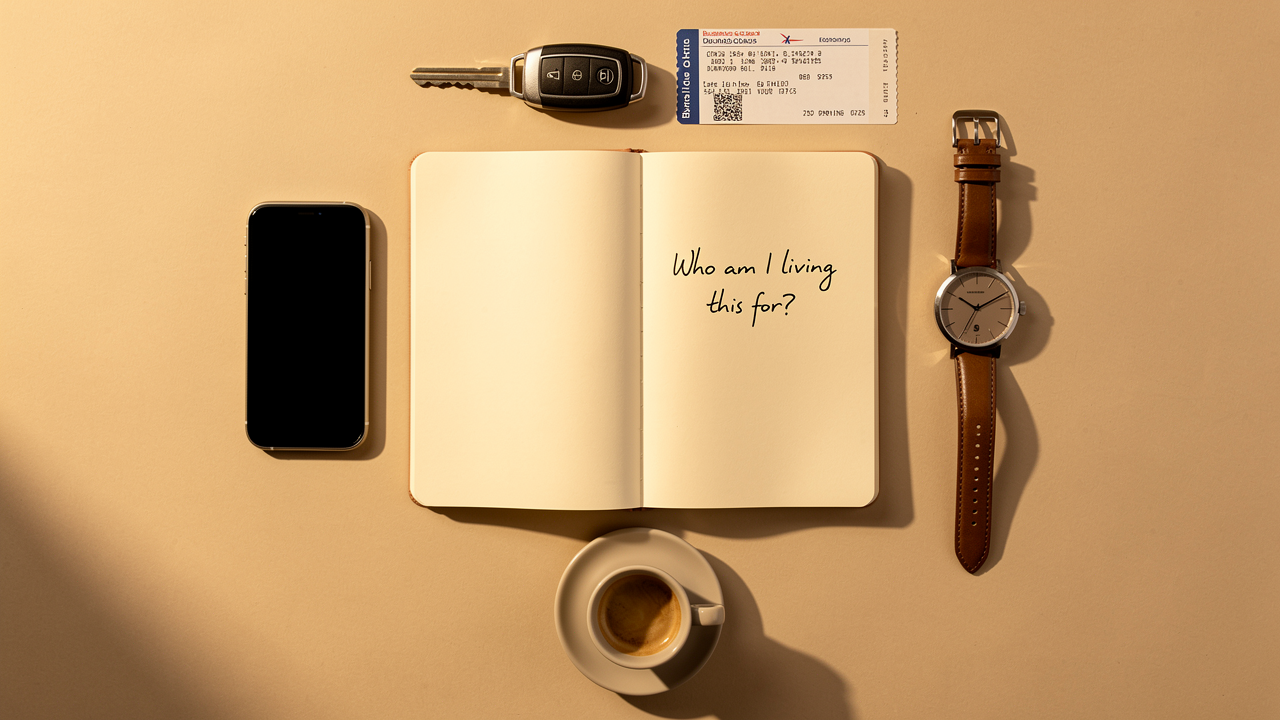
# I Stopped Calling It the Good Life and Asked Who I Was Living It For
I said it out loud and then just sat there.
“Good life.” Like I was pitching it. Like I was at a closing table describing someone else’s property.
The lake was maybe a mile away. Hollie was in the next room. I had the business. I had the kayak in the garage, the rods rigged and ready, a morning with nothing urgent on the calendar. And I was narrating it like a case study instead of just being in it.
That gap — between what was actually there and what I was doing with it — that’s the thing I haven’t been able to shake.
—
## I Wasn’t Building a Life. I Was Building Evidence.
If you came up short on money, short on being taken seriously, short on being chosen by whatever room you walked into — you built something. That’s the move. You got to work and you made something real.
And then you kept building. Not because the threat was still there. Because the *habit of proving* outlasted the need for proof.
The contractor finishing bids at 10:47 p.m. because that’s the only quiet left in the day. The consultant with the laptop open during the school event because a client might need one more revision. The service business owner who can’t stop checking messages because the business only *feels* safe when he’s watching it. These people aren’t broken. They built exactly what they learned to build. The logic was sound. The timing just never got updated.
A 2025 survey reported that 82% of entrepreneurs said they lost sleep over work-related concerns. Which means the “I’ll feel better once it works” story is a lot thinner than most people want to admit. Because it never quite *works* enough. There’s always another threshold. Another proof point. Another version of the number or the title or the recognition that would finally close the case.
The external verdict often never arrives. And the body keeps paying the price while the mind keeps waiting for permission.
—
## The Audience I Never Named
Here’s the part that’s harder to say.
The life I was describing — the “good life” I was narrating out loud to no one — I started asking who it was actually for. And the honest answer wasn’t Hollie. Wasn’t the lake. Wasn’t me at 48 sitting in a house in North Idaho feeling like I finally got somewhere.
It was for someone from a long time ago. Maybe a version of me that got told no too many times, or moved too many times, or fit in just enough to get through but never quite enough to belong. The shapeshifting years left a specific kind of residue: *who I am as myself isn’t enough to be accepted.* That doesn’t evaporate when the income changes. It goes underground and drives from there.
So you build. And the thing you’re building is evidence. Evidence that the verdict was wrong. Evidence that you were worth something after all.
The problem is the invisible audience doesn’t update its verdict. You can keep earning and they’ll keep requiring more. Or they’re already gone — moved on, passed on, just *gone* — and the performance is running to an empty room.
**Who were you trying to convince?**
I’m not asking that rhetorically. I mean actually sit with it. Because until you name it, you cannot aim at anything else.
—
## The Calendar Tells the Truth Faster Than the Mouth Does
You can say you want freedom. The calendar will tell you whether you built it or just built a more polished version of the same obligation.
Here’s what I’ve seen, including in myself:
– Says he wants flexibility. Has: back-to-back commitments that answer to someone else’s urgency every time the phone buzzes.
– Says she wants to be present. Has: inbox open at dinner, phone on the dock, half-there during the conversations that actually matter.
– Says he wants a business that works without him. Has: himself as the single point of failure for every process that touches revenue.
None of that is laziness. None of that is a character flaw. It’s a pattern. And patterns have origins.
If the life only works when you’re missing from it — that’s not freedom. That’s a well-decorated obligation.
The question isn’t “how do I get more time?” The question is: **what does your calendar say you believe you’re still trying to prove?**
Take one week. Look at it honestly. Not the story about what you’re building toward — the actual week, the actual hours, where the actual attention went. The calendar doesn’t lie. The mouth does.
—
## What the Systems Actually Revealed
I built automation systems because conventional tools weren’t built for how I actually operate. And when they started working — when the follow-up ran without me, when the pipeline moved without me checking it every four hours, when I came back after three days and nothing had waited for me — I noticed something.
Some operators don’t know what to do with the space.
They fill it. They create urgency where there isn’t any. Because free time without a clear answer to *what it’s for* is uncomfortable in a way that busy never is. Busy is familiar. Busy feels like proof of something.
That’s when I understood: automating the business was never the finish line. It just removed the excuse. It returned the time. But returning time to someone who hasn’t answered the prior question — *what are you returning your presence to?* — is just giving them a cleaner cage.
AI’s job isn’t to replace your presence. It’s to give it back. More headspace. More clarity. More of you available for the conversations that matter, the relationships that deserve your full attention, the Tuesday on the lake that isn’t contingent on everything being handled first.
But that only lands once you’ve named what you’re returning to.
—
## The Life That’s Actually Mine
I’m not writing this from the top of something. I’m writing it from inside still working on it.
The “good life” I was narrating — I think it was real. I think I meant it. But I was describing it to an audience that wasn’t there instead of just living it with the people who are.
Hollie in the next room. The lake down the road. A Tuesday morning with nothing urgent. That’s not a brand asset. That’s mine. And the difference between performing it and actually living it is exactly as wide as the distance between the person you’re trying to convince and who you actually are.
At some point you have to stop asking whether it looks good enough and ask whether it feels like yours.
I’m still asking. But at least now I know who the question is actually for.
—
*I write here regularly — real estate, AI tools I actually use, life on the water, and occasionally, this kind of thing. If any of that sounds worth your time, follow along or subscribe. No hype. Just what’s real.*