
I Stopped Calling It Home and Asked What I Was Actually Staying For

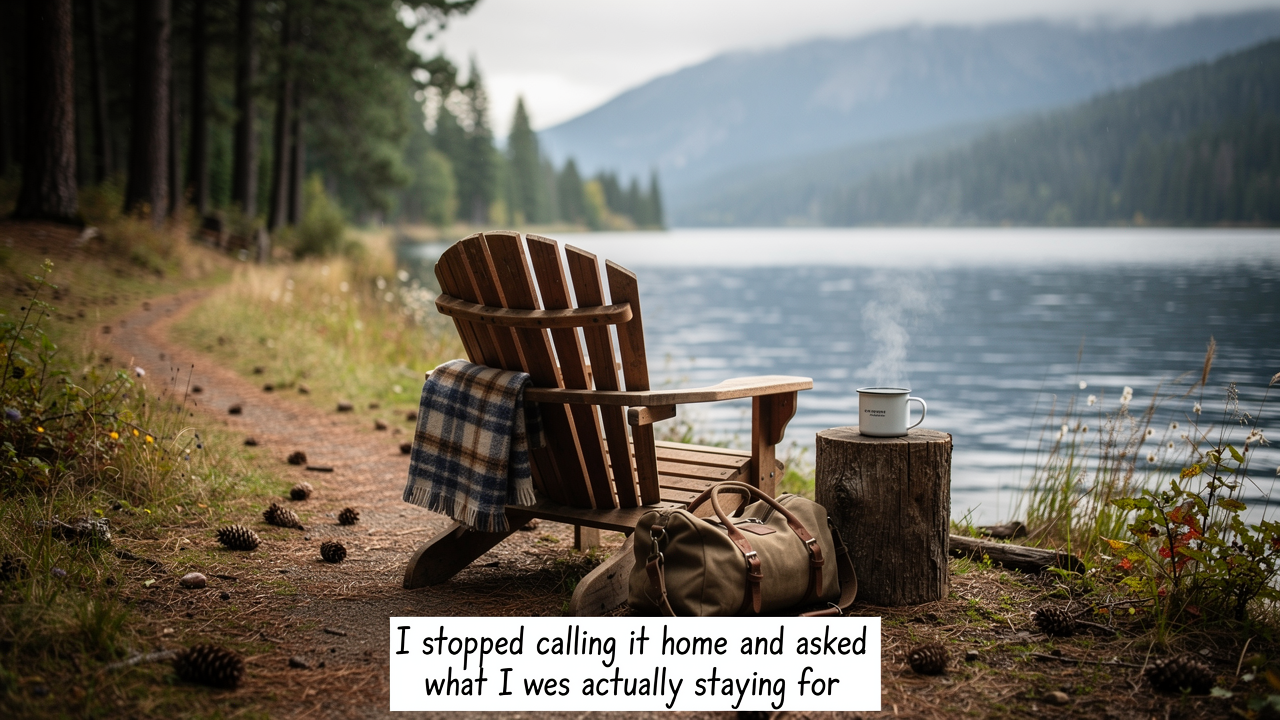
# I Stopped Calling It Home and Asked What I Was Actually Staying For
There’s a difference between not leaving and choosing to stay.
Most people never run that distinction. I didn’t for a long time.
—
Not moving isn’t a decision. It’s what happens when you run out of reasons to go. The boxes get unpacked, the address gets updated, the routine builds up around you — and at some point you look around and call it home because that’s what you’re supposed to call it.
But “choosing to stay somewhere” is a different act entirely. It means you looked at the place, looked at your life, and said *this one*. Not by default. Not because the business happened to be here. Because you actually decided.
I hadn’t done that. Not until relatively recently.
—
## Four Schools. Three States. One Conclusion.
I went to four high schools across three states. Freshman year, then Mill Creek, then Missoula senior year. Every time, the same exercise: figure out who fits, read the room, become enough of what was needed to get through the year.
It teaches you to be mobile. Not just physically — emotionally. You learn to scan the room before you put anything down. You keep yourself available for the next configuration.
The lesson I actually took from all of it wasn’t adaptability. It was quieter and more damaging than that: *who I am as myself probably isn’t good enough to be accepted by all these different groups*. So you adjust. You become whoever fits. And you stop counting on any specific place to hold you.
Senior year in Missoula, I ended up in the goth and alternative crowd — not by choice exactly, but by process of elimination. Not a jock, not a redneck, not fitting anywhere that already had a shape. What I remember about that group is that they welcomed outsiders. That wasn’t nothing. It was the closest to belonging I’d felt in years.
But even then, I wasn’t choosing. I was landing somewhere that would have me.
That pattern outlasted high school by a long time.
—
## I Didn’t Move to North Idaho. I Just Stopped Leaving.
The business was here. The real estate license was here. Hollie was here. Life was here.
For a while, that felt like a choice. But none of those things were a decision about the *place*. They were accumulation. Things that happened to land in the same zip code.
At some point the question came up — not dramatically, not as some moment on a ridge with a view — just quietly, the way the real ones usually do: *what am I actually staying for?*
And I realized I’d never answered it. I’d just kept not leaving.
**Home is not where you’re living. It’s where your identity stops negotiating.** It’s the first place you stop waiting to see if you’re going to stay.
North Idaho was the first place I actually made that call. Not because the mountains are stunning or because the lake is right there or because the pace makes sense to me — though all of that’s true. Because I looked at it and made an actual decision instead of just letting the days accumulate.
That feels like a small thing. It isn’t.
—
## A Chosen Place Demands a Different Kind of Business
When location is provisional, everything around it is provisional.
The calendar. The client commitments. The systems. The hours you protect and the ones you give away. If you’re still subconsciously building like you might leave tomorrow, it shows up in every structure you create. You don’t build for permanence. You build for portability.
An operator who chose a life outside their business builds differently than one who’s still parked in it.
There was a week not long ago where I didn’t open the laptop for three days. Not planned, just happened — life was pulling in a different direction and I let it. Came back and found the pipeline had run, leads were scored, content had published. Nothing had waited for me.
That’s not a productivity story. That’s what a business looks like when you’ve actually decided you’re staying somewhere and you want to be present while you’re there.
Efficiency is the mechanism. Presence is the point. If the system just saves you time but you fill that time with more work, you haven’t chosen a life. You’ve just made the job faster.
In real estate, this shows up clearly. An agent who’s actually planted somewhere shows up differently than one who’s just licensed there. The clients I work with at Epique get professional photography on every listing — covered entirely by the brokerage, no out-of-pocket hit to the seller. We layer in AI-enhanced imaging on top of that: better lighting, virtual staging, seasonal views that help out-of-state buyers picture themselves in the space. That combination exists because the brokerage was built for agents who are staying in their markets and building something real in them.
You can tell the difference. It’s not subtle.
—
## What’s Different Now
The place didn’t change. The decision did.
I stopped treating North Idaho as the backdrop and started treating it as the choice. That sounds simple. The effect isn’t.
What you protect changes. What you build changes. The kind of growth you pursue changes when you’re not building for exit. The clients you keep, the hours you fence off, the answer you give when someone texts at 11 PM — all of it shifts when the address is no longer provisional.
I’m not going to tell you it all clicked at once or that there was a clean before-and-after. That’s not how it works. What I can tell you is that the architecture of the business started reflecting the architecture of the life I was actually trying to build, instead of running parallel to it and never intersecting.
North Idaho isn’t the first place I lived. It’s the first place I stayed on purpose.
That gap — between living somewhere and choosing it — is the size of your whole life.
—
Here’s the question I’ll leave you with.
Not where do you live. You know that.
*When did you actually choose it?*
And if the answer is “I’m not sure I did” — what are you still building like you might leave tomorrow?