
The Stack Is Never Fair. That’s Not the Game’s Problem.

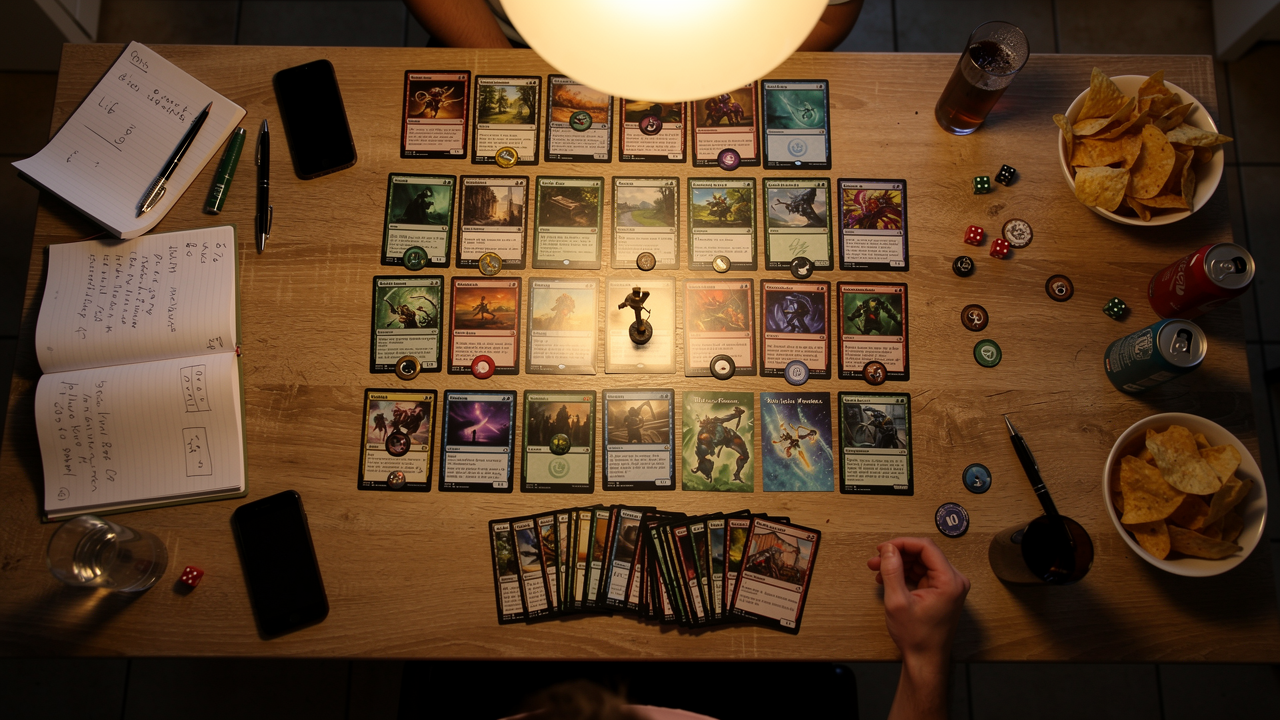
# The Stack Is Never Fair. That’s Not the Game’s Problem.
Someone pushes back from the table. Shakes their head. “Mana screwed again.”
Or the other version: “This game is so broken.”
I don’t say anything. But I’m about to write it down.
The game is not unfair. You’re playing like you were promised something the game never offered.
—
## You Didn’t Get Unlucky. You Kept the Wrong Seven.
Let’s talk about the one-lander.
You fan out your opening hand. Two-drop, three-drop, a removal spell, a finisher. One land. You’re on the draw, so you think — I’ve got seven cards, the hand has action, the deck will give me what I need.
And right there, before a single spell resolves, you’ve already made the mistake.
Wizards is blunt about this. The mulligan decision isn’t “does this feel okay?” The question is: does this hand have a realistic route to doing something in the first few turns? That’s the whole test. Can this hand execute a plan, or does it need the deck to cooperate before it can even start?
A one-lander on the draw needs the deck to cooperate. You’re not playing a hand. You’re placing a bet.
And the midrange hand — the one that has lands and spells but the lands don’t cast the spells — that’s not a keep either. It *looks* like a keep. It has cards in it. It will lose slowly, politely, and somewhere around turn five you’ll blame the top of your deck for not bailing you out.
The control player who kept the reactive hand and never hit land four. The problem is not bad luck. The problem is a keep decision made as if the game owed a clean draw pattern.
It didn’t. It doesn’t. It never said it would.
—
## The Stack Isn’t Rigged. It’s Just Indifferent.
Most of what gets written about variance lands somewhere around: accept randomness. Which is true. But it’s not the whole thing.
Here’s the sharper version.
Good players don’t complain less about variance. They make fewer decisions that depend on variance being kind.
That’s different. That’s not a mindset shift. That’s a process shift.
The stack hands everyone a mix of good positions and bad ones. The skill is not finding a way to draw the good ones more often. The skill is not handing the game away before the variance even gets a chance to matter.
“Play your outs” gets thrown around like it’s a motivational poster. The actual version is harder: you do not get to demand your ideal line because the game state would be cleaner if you had it. You play from where you are. You look at what’s on the board, what’s in your hand, what the opponent’s likely holding — and you find the next correct decision. Not the ideal one. The correct one from this specific position.
People rage-quit because they think they’re losing to unfairness. They’re actually losing to expectation. They wanted the hand they deserved. They got the hand they were dealt. Those two things were never the same thing, and the game never promised otherwise.
—
## The Contractor Keeping a One-Lander at 11 p.m.
Here’s where it gets uncomfortable.
The contractor answering emails at 11 p.m. because every client “just needs one quick thing.” That’s not a time problem. That’s a hand that was never going to curve out — and he kept it anyway. He built a week that only works if every draw is clean. No margin, no recovery line, no outs.
The consultant who misses the thing she promised to be at because one deliverable kept slipping and the week had no slack. Same hand. Wrong keep.
The coach whose Sunday disappears into inbox triage, payment chasing, and follow-up emails. She didn’t get trapped by one bad week. She built an operating system that requires favorable conditions to function. And conditions are not favorable. They are indifferent. Same as the stack.
I had a stretch — three months, nothing moving, money tight — where the pipeline was dead quiet. And when I looked at it honestly, the pipeline had stopped because it needed me to touch it every day. I’d built a hand that couldn’t play itself. That’s not bad luck. That’s the keep decision I’d already made before the game even started.
Most people don’t fail because they lack effort. They fail because their process only works when conditions are favorable.
—
## Build for Recovery. Not for Comfort.
The real skill — and I mean in MTG and in everything else — is making the next correct decision from a bad position.
That’s not resilience. Resilience is a mood. This is a process.
The player who sequences correctly from behind, who finds the one line that still wins, who doesn’t let frustration bleed into worse decisions — that player is good because they’ve practiced thinking clearly when it’s ugly. Not because they drew better.
A system that keeps running when you step away from it isn’t a luxury. It’s the mulligan policy. You build it before you need it. You don’t design your business around the assumption that every week will cooperate. You design it to survive the weeks that don’t.
That’s what I was actually building when I started wiring automations together. Not because I wanted to work less. Because I’d already learned what happens when the pipeline depends on heroics. It stops. And it stops at the worst time.
A good system still has rough days. The difference is it doesn’t need you to fix every draw.
—
## The Game Was Never Going to Be Fair. That Was Always the Point.
Sometimes you do everything right and still lose. That’s the game. It has always been the game.
The goal isn’t to avoid bad positions. Bad positions are the game. The goal is to reduce how often you hand it away before it even gets to the variance.
The stack is indifferent. Your decisions aren’t.
That’s where the gap lives. That’s where the work is.
If this landed and you want to talk about what that actually looks like in your business, you know where to find me.