
Task Paralysis: The 3am Existential Staring Contest My ADHD Brain Always Wins

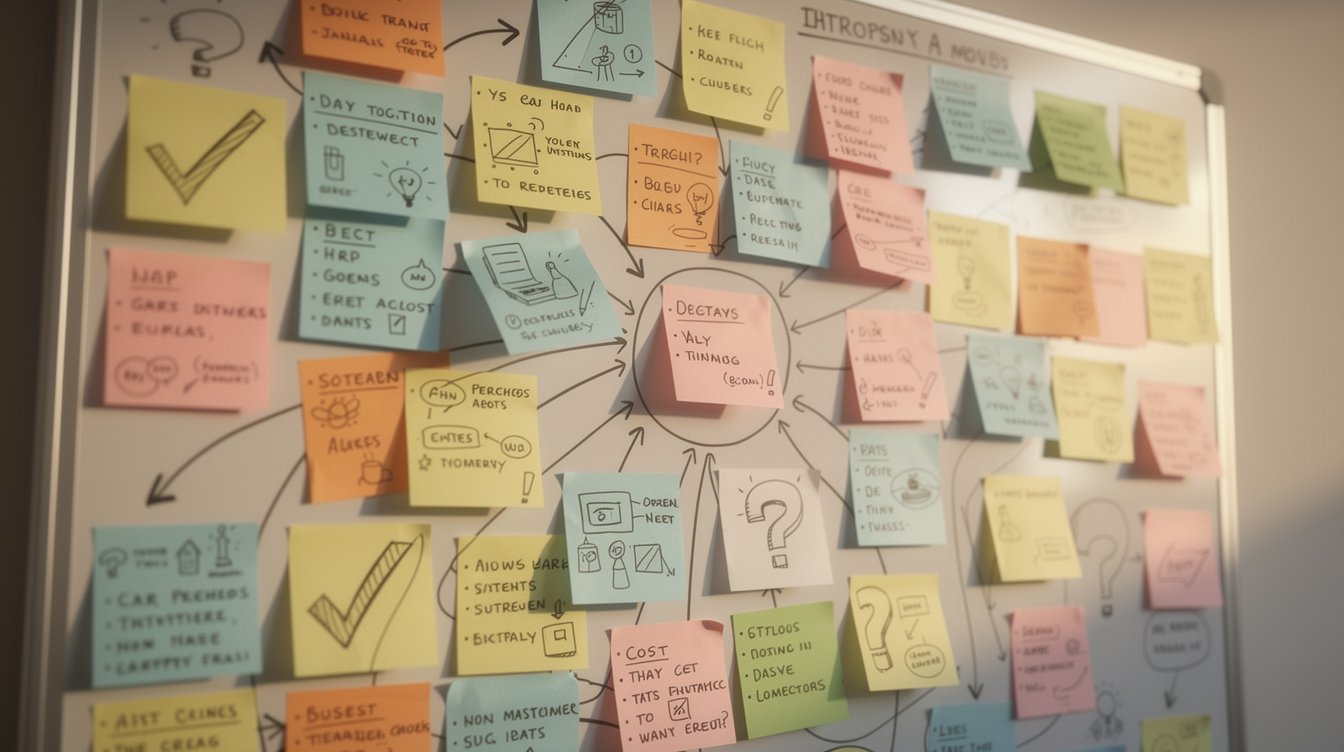
# Task Paralysis: The 3am Existential Staring Contest My ADHD Brain Always Wins
It’s 3:14am. I know it’s 3:14am because I looked at my phone specifically to avoid looking at the email I still haven’t answered.
The email isn’t complicated. I know exactly what to say. I’ve mentally drafted it six times in the last four days, twice while fishing, once in the shower, and apparently now at three in the morning while staring at a ceiling fan that isn’t moving.
This is task paralysis. Not insomnia. Not anxiety in the clinical sense. Just my ADHD brain running a very thorough, very unhelpful security sweep on one task that should take eleven minutes to complete and has instead colonized a week of background mental real estate.
And the absurd part — the part that would be funny if I weren’t so tired — is that I already know how this ends. I’ll do the thing tomorrow, probably between two other things, and it’ll take eleven minutes exactly. The paralysis wins tonight. The task gets done tomorrow. And then we do this again in about nine days with a different email.
—
## The Lie I Used To Tell Myself at 3am
For a long time the story I told myself was simple: *I’m just bad at follow-through.*
Not ADHD. Not executive dysfunction. Just a personal failing dressed up in self-awareness so it sounded like honesty. “I know my weaknesses.” Yeah. You also know exactly what they are and still haven’t done anything about that email.
The shame version of this story is convincing because it sounds like accountability. “If I cared enough, I’d have done it.” “Organized people don’t have eleven undrafted emails living in their brain.” “I need to be more disciplined.”
That story is a con. A sophisticated one. It sounds like taking responsibility, but it’s actually a productivity costume on a complete misread of what’s actually happening.
So let me tell you what’s actually happening.
—
## It’s Not a Motivation Problem. It’s a Negotiation.
**Most productivity advice treats task paralysis like a scheduling problem.** For ADHD brains, it’s usually a negotiation problem.
Here’s the thing the Cleveland Clinic actually gets right in plain language: the ADHD brain has weaker directed attention and stronger automatic attention. That means when you’re doing something — anything — your brain is running on automatic. Smooth. No cost. But when you need to stop and deliberately redirect to a specific task? That redirect has a price. And for ADHD brains, that price can feel wildly disproportionate to the actual task.
I can spend six hours on tournament prep. Maps, wind patterns, structure charts, rigging up rods the night before — zero hesitation, zero friction. I am a man possessed. Then I sit down to answer three messages about that same tournament and suddenly I’m staring at the floor like someone asked me to file my own taxes in Mandarin.
The fishing prep didn’t get easier. The messages didn’t get harder. The activation cost is just completely different. One task has immediate sensory reward baked in. The other requires me to start without knowing how it lands, without seeing the result, and without the dopamine hit of doing something I can feel moving.
That’s not laziness. That’s a brain running a security check on whether the task is safe enough to begin.
—
## What’s Actually On the Table When the Task Feels Impossible
The task is rarely just the task.
I know a contractor — very competent, works constantly, customers love him — who answers texts at 11:47pm because he cannot face a 14-message thread from a client asking about a change order. He tells himself he’s being responsive. He is. But he’s also avoiding the moment where he has to decide what to charge, whether to push back, and whether any of this turns into conflict. It’s not the text. It’s the negotiation inside the text.
I’ve done the same thing as a real estate agent. I can write a listing description in twelve minutes. Good one too. But a tough pricing conversation with a seller I like? I’ve circled that for three days, drafting the opening sentence in my head every time I drive somewhere, never once picking up the phone.
The skill wasn’t the problem. I know how to have that conversation. The problem was that the conversation carried:
– Possible conflict
– Uncertainty about how they’d take it
– The chance of disappointing someone I want to help
– A silent referendum on whether I know what I’m talking about
– A threat to my identity as someone who gets this right
None of that is on the calendar entry. All of it is on the activation cost.
Tasks stall out when they carry hidden weight like that. When they’re socially loaded. When the emotional consequences are uncertain. When they have too many internal steps living only inside your head with no external scaffold to hold them. When completing them requires you to start without knowing if you’ll like where they land.
The size of the task doesn’t matter as much as the size of what the task *represents.*
—
## Why 3am Is Actually the Honest Hour
Here’s the thing about 3am: your brain isn’t suddenly wiser. It’s just out of distractions.
All day there’s enough input — enough urgency, enough stimulation, enough “I’ll get to that” — to keep the unresolved tasks from getting airtime. My brain is remarkably good at this. It can hold an unanswered email in a kind of ambient suspension for seventy-two hours without letting it fully surface. This feels like functioning. It is not functioning.
At 3am the buffer runs out. There’s no next thing. No call coming in, no listing to review, no podcast filling the car. Just the ceiling and the list of things I’ve been successfully not-starting.
The 3am staring contest isn’t a character flaw. It’s a symptom of unresolved initiation load that the daytime brain kicked down the road until there was no more road.
That’s actually useful information. If the same three tasks keep showing up at 3am, they’re not random. They’re the ones with the highest activation cost. My brain is telling me something — not that I’m lazy, but that these specific tasks need a different kind of entry point.
—
## The Productivity Advice That Made It Worse
I’ve tried the apps. The frameworks. The time-blocking. The color-coded calendar that I maintained for eleven days before abandoning it like a campfire at dawn.
The advice isn’t wrong exactly. It’s just solving the wrong problem.
“Just break it into smaller steps.” — Fine. But if the small step still carries emotional charge, smaller doesn’t make it safer.
“Try for five minutes.” — Sometimes this works. More often the issue isn’t duration. It’s entry. I can’t do five minutes of something I haven’t found a way to start.
And here’s the one that really gets me: ADHD brains are famously good at building elaborate systems to avoid one uncomfortable task. Templates. Color coding. Research rabbit holes. Reorganizing the capture system. That’s not prep — that’s avoidance wearing a productivity costume. I know because I’ve done it spectacularly well.
**More structure is not always the answer.** If the structure doesn’t address why the task felt unsafe to begin, you just have a more organized pile of things you’re still not doing.
—
## What Actually Lowers the Activation Cost
Here’s what I’ve found actually works for my brain. Not theoretically. Actually.
Pre-written replies for the messages I consistently freeze on. Not because I’m lazy — because I shouldn’t have to re-negotiate the same boundary, the same pricing disclaimer, the same follow-up language from scratch every single time. The decision tax on “how do I say this?” is enormous. Remove the decision, remove a chunk of the cost.
Binary choices instead of open questions. Not “what should I do next?” but “is this a yes or a no?” My brain handles a fork in the road better than it handles a field with no road at all.
A minimum viable entry point. Not the task. Just the thing that puts me in proximity to the task without requiring a full emotional warm-up. Open the email. Read it. Don’t answer yet. That’s the whole job for right now. Sometimes the brain accepts that deal.
And defaults. Defaults that hold when the system inevitably breaks for three days — because it will break, and that’s not failure, that’s ADHD being ADHD. The question isn’t “how do I build a system that never fails?” It’s “how do I build a system that doesn’t require me to be a perfect user to function?”
This is actually a lot of what drove me to build automations. Not to do more. To stop re-deciding the same things. The win isn’t efficiency. It’s not having to fight my own brain over whether to send a follow-up message at 7pm when I’m already running on empty.
—
## The Ending That Isn’t Really an Ending
I still have the 3am staring contest. Still. I know how my brain works, I’ve built systems around it, and I will still find myself at 3-something in the morning having a philosophical standoff with an email about a closing document.
The difference is I stopped treating that as evidence that I’m broken.
My brain is running a security check. It does this. The job isn’t to be more forceful with it — more disciplined, more willing, more “just do the thing.” The job is to lower the friction on the entry point until the check clears. Build defaults. Pre-decide the decisions. Make the first move so small it barely registers as a threat.
Adulthood with ADHD isn’t about becoming harder on yourself until you comply. It’s about learning how your brain asks for safety before it moves — and building a life that answers that question before it has to be screamed at you from a dark ceiling at 3am.
If this landed somewhere specific, if there’s a task that’s been living in your head for three days that you know exactly how to do and still haven’t started — that’s the one worth looking at. Not with more pressure. With more curiosity about what it’s actually costing you to begin.
I write about the systems side of this at FlowStateOps — specifically how automation can take the decision tax off the tasks ADHD brains consistently flag as threatening. And if you’re in North Idaho and one of those frozen tasks happens to be a real estate decision, that’s a different conversation. Same honesty. You know where to find me.