
Why MTG Deck Building is Actually World-Building in Disguise

# Why MTG Deck Building is Actually World-Building in Disguise
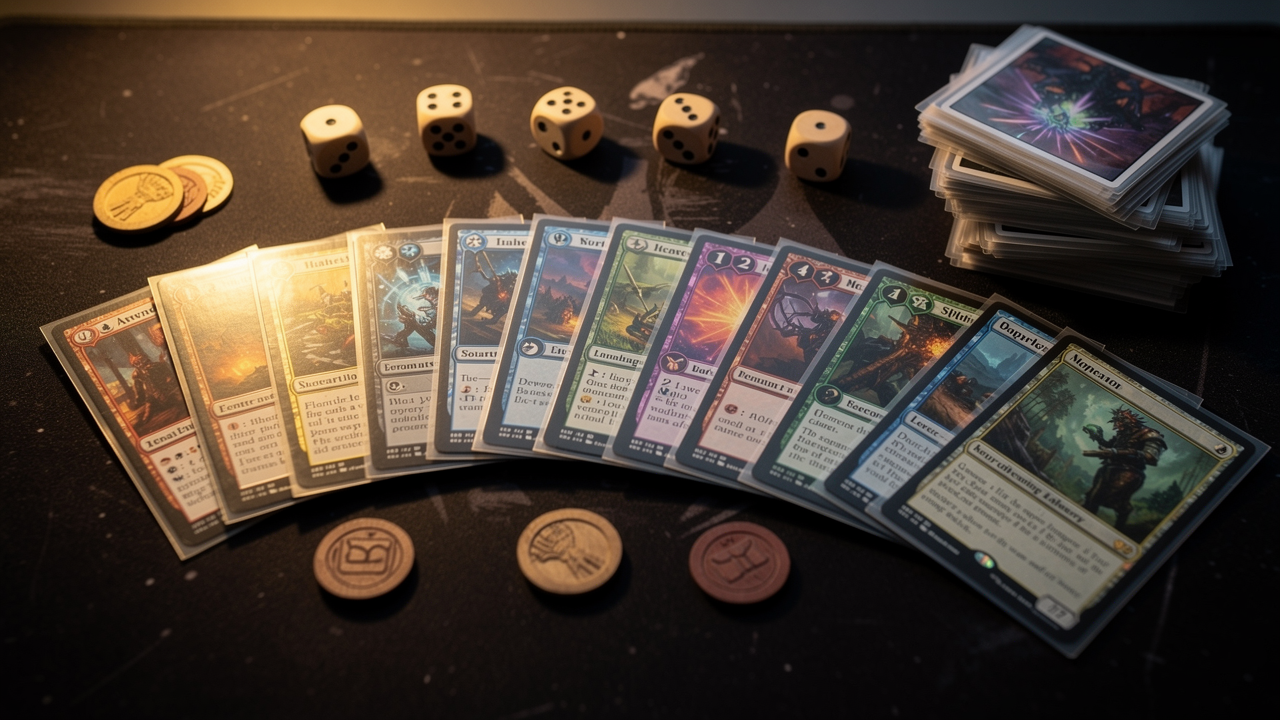
The first time I watched a Magic: The Gathering deck create a story without a single written word, I realized we weren’t just playing a game. We were architects of living, breathing universes.
Most people see Magic as cardboard and math. They’re wrong. This game is humanity’s most sophisticated narrative design simulator—a platform where complex systems don’t just emerge, they *breathe*.
Imagine designing an entire world where every card is a character, every interaction a potential plot twist. Where the constraints of your design determine not just whether you win, but **what story unfolds**. That’s not game design. That’s world-building.
## The Hidden Architecture of Emergent Stories
In competitive deck building, cards aren’t just numbers. They’re ecosystem inhabitants with intricate relationships. A blue control deck isn’t just a strategy—it’s a society that survives through information control. A red aggro deck isn’t about damage; it’s a culture of pure, immediate action.
Consider how deck synergies mirror cultural interactions:
– Tribal mechanics show how shared identity creates collective power
– Color interactions reveal philosophical conflicts
– Combo potential demonstrates how unexpected connections birth transformation
The Weatherlight Saga isn’t just Magic’s most famous storyline. It’s a masterclass in how mechanical constraints can birth incredible narratives. Imagine building a deck where each card is a crew member, each interaction a potential plot point. Your playtest becomes a story generation engine.
## Why Most Deck Builders Miss the Point
Here’s the hard truth: optimization kills narrative emergence.
Most players ruthlessly cut “inefficient” cards, turning potentially rich worlds into sterile mathematical equations. But real storytelling happens in the margins—in those weird interactions nobody saw coming. My ADHD brain knows this instinctively: constraints are storytelling’s oxygen.
A janky two-card combo that barely works? That’s not a weakness. That’s **potential energy**.
## The Jeff Halligan Playtest Method
After years of competitive play, I’ve developed three rules for building narrative-rich decks:
1. **Embrace Complexity, Not Perfection**: Your first 10 playtests will reveal more about your “world” than 100 hours of theorycrafting.
2. **Watch for Unexpected Interactions**: The most interesting stories emerge when cards do something they’re “not supposed” to do.
3. **Cut Brutally, But Strategically**: Every removal is a narrative choice, not just a mathematical optimization.
My kayak bass fishing brain understands this intimately. On the water, you don’t control the entire ecosystem—you create conditions for interesting encounters. Same with deck building.
## Worlds Are Not Designed. They Emerge.
Magic isn’t just a game. It’s a narrative simulator that teaches us how complex systems actually come alive. Every deck is an experiment in emergence, every playtest a glimpse into how stories spontaneously generate from constrained interactions.
Next time you shuffle up, remember: you’re not just playing a game. You’re birthing a universe.