
Why Tournament Bass Fishing Is Better Than Therapy (And Cheaper)

# Why Tournament Bass Fishing Is Better Than Therapy (And Cheaper)
2 AM. Dead-silent lake. My kayak drifts in the dark two hours before launch, and I’m running decision trees in my head like a junkie counting exits. Tournament pressure does that — turns you into a chess player who can’t see the board yet.
Most people think fishing is therapy. Cast out, relax, breathe deep. Maybe catch something.
Tournament bass fishing is the opposite of that.
It’s a mental cage match where the opponent is you, the bass are witnesses, and every decision reveals exactly who you are when nobody’s watching. I’ve learned more about my patterns, my breaking points, and my bullshit excuses in three years of competitive kayak bass fishing than I did in actual therapy.
And yeah, it’s way cheaper.
## The Therapy Myth Nobody Questions
Recreational fishing gets sold as passive healing. Vitamin D. Stress relief. Cast and zen out. The internet loves that story because it’s comforting and requires nothing of you except showing up with a rod.
Tournament fishing strips that fantasy bare in the first ten minutes.
Kevin VanDam — arguably the greatest bass angler alive — says mental preparation is 80% of tournament success. Not gear. Not secret baits. Mental prep. The work you do before you ever touch water.
That’s not therapy. That’s exposure therapy at high speed with a scorecard.
The difference matters because recreational fishing lets you blame jet skis, weather, moon phase, whatever. Tournaments force accountability. You can’t hide behind excuses when your over-practiced spot goes cold because you educated the bass population catching them all week.
I know. I’ve done it.
## Three Tournament Lessons No Therapist Will Tell You
### Lesson 1: Your Patterns Are Showing
Bass behavior mirrors professional burnout in ways that would be funny if they weren’t so brutal.
Last summer I fished a local series event I’d been grinding for weeks. I’m talking hours every evening after showings, mapping structure, finding staging areas, catching fish to “confirm the pattern.” Tournament day comes and I blank for six hours. Not a single keeper.
What happened?
I caught too many bass in practice.
Elite tournament anglers know something most people never learn: Practice isn’t about catching fish. It’s about not catching them. You idle through water with hooks out, mapping reactions without depleting the population. Catch 80% of your tournament fish in 20% of your pre-fished water by leaving spots alone.
Over-practicing kills tournaments because bass learn. They get wary. They need recovery time post-bite.
Sound familiar?
That’s every solopreneur who over-delivers for top clients until those clients burn out on the relationship. That’s every contractor glued to email at 11 PM instead of tucking kids in, grinding “one more client touchpoint” until the touch becomes a shove.
Strategic restraint beats constant grinding. The bass taught me that. Therapy just kept asking how I felt about it.
### Lesson 2: Pressure Doesn’t Break You, It Reveals You
I’ve got ADHD. Diagnosed as an adult after decades of thinking I was just bad at life.
Kayak bass tournaments are the only arena where my brain’s chaos becomes an edge.
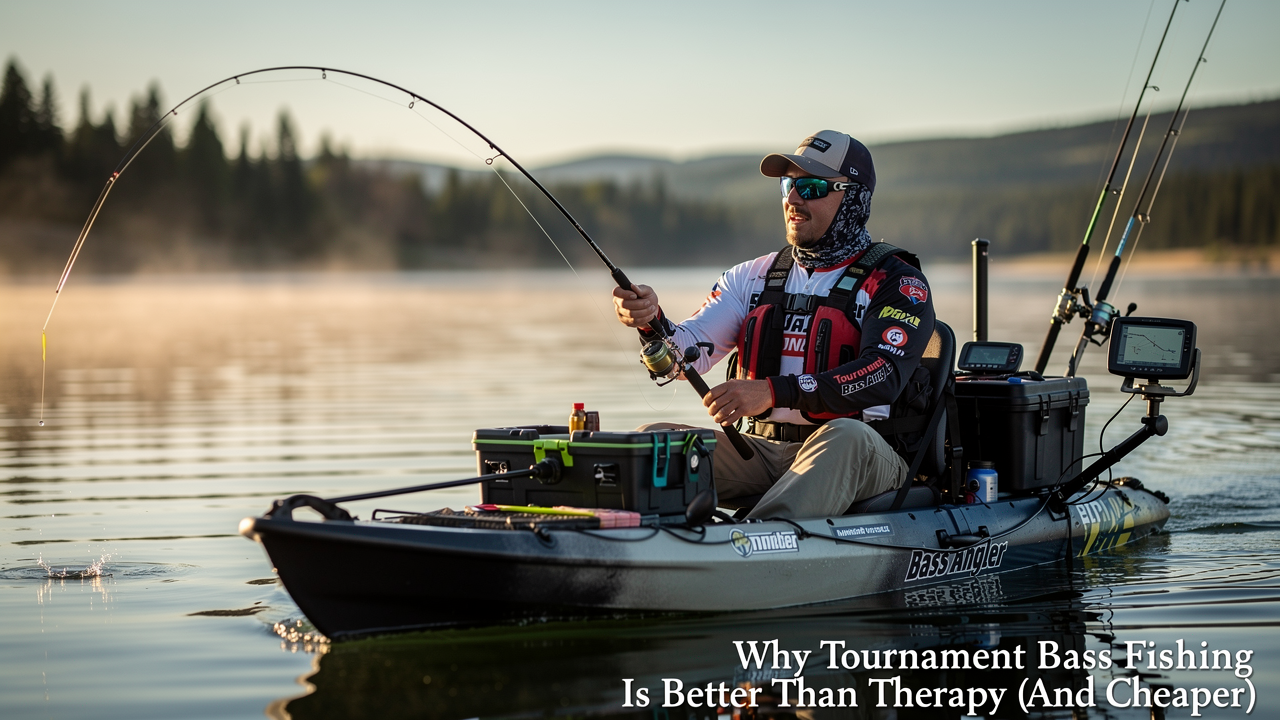
Here’s why: A kayak has constraints a bass boat doesn’t. No live well to keep fish alive all day — you catch, photograph, release immediately. No trolling motor to hold you on a spot — you fight wind and current with a paddle. No space for twelve rods rigged with every lure ever made — you choose three setups and live with it.
Limitations force hyper-focus.
My ADHD brain can lock onto a single bass for four straight hours if the variables are right. I’ll notice a ripple pattern most people miss because I’m watching seventeen things at once and only one of them matters right now.
In normal life, that same brain spins out on email threads and forgets I scheduled a showing.
Tournaments don’t break you. They reveal what you actually are when the stakes get real and the excuses run out.
I learned more about managing my attention in Year 2 of competitive fishing than I did in two decades of “trying harder” at desk work.
### Lesson 3: Recovery Is a Competitive Strategy
Bass need 24-48 hours to reset after heavy fishing pressure. If you hammer a spot on Tuesday, it’s dead by Thursday.
Nobody tells you that when you’re starting out. You think more time on the water equals better results.
It doesn’t.
I bombed a regional qualifier because I fished my primary area too hard the week before. Day of the tournament, those fish were ghosts. I had no backup plan because I’d over-committed to a single pattern.
Elite anglers like Jonathan Kelley talk about mental and physical balance as non-negotiables. Sponsor commitments, family time, off-water recovery — all of it feeds back into tournament performance.
This isn’t soft advice. It’s tactical.
Recovery is a competitive strategy, not a luxury. Bass know it. Your body knows it. Your business knows it even if you don’t.
I’ve started building “client cooldowns” into my real estate CRM. Automated gaps that prevent over-contact the same way I now leave tournament spots alone between practice sessions. Turns out boundaries aren’t weakness — they’re how you keep the population healthy for the next engagement.
## The Hard-Earned Insight
Tournament fishing functions as a real-time personal development workshop with no instructor and no safety net.
You make a decision at 6 AM that determines whether you weigh fish at 2 PM. Nobody holds your hand. Nobody validates your feelings about the weather. The bass either bite or they don’t, and why they didn’t is on you to figure out.
Intentional idling matters more than constant action.
I spent eighteen months thinking tournament success meant more hours on the water. More practice trips. More patterns logged. More intel gathered.
Then I watched a guy win a regional by fishing two spots all day — spots he’d barely touched in practice because he knew over-fishing would kill them.
He idled. Observed. Mapped reactions without educating the population. Showed up tournament day with fresh fish and a plan.
That’s the bridge from water to work.
Decision trees in fishing look exactly like decision trees in business. If this client demographic responds to X approach, do I burn it out in discovery calls or hold it for high-value proposals? If this marketing channel works, do I flood it or pace deployment to stay under saturation thresholds?
The answers are the same. Sustainable wins demand restraint.
## The Challenge
I’m not telling you to go fishing.
I’m telling you to examine your own performance patterns with the same honesty a tournament forces.
Where are you over-practicing? What spots are you burning out by grinding them too hard? What would change if you treated recovery as a competitive advantage instead of a moral failing?
Therapy asks how you feel about your patterns.
Tournaments make you live with the consequences until you fix them.
There’s deeper work waiting beyond surface-level “relaxation.” The kind of work that doesn’t happen on a couch, but in the moment when you’re two hours into a tournament skunk and have to decide whether to abandon your plan or trust the process.
That’s the real lesson.
The bass are just witnesses.